DigitalSeedly

Meta Ads for small business — beginner's guide to Facebook and Instagram ads in 2026

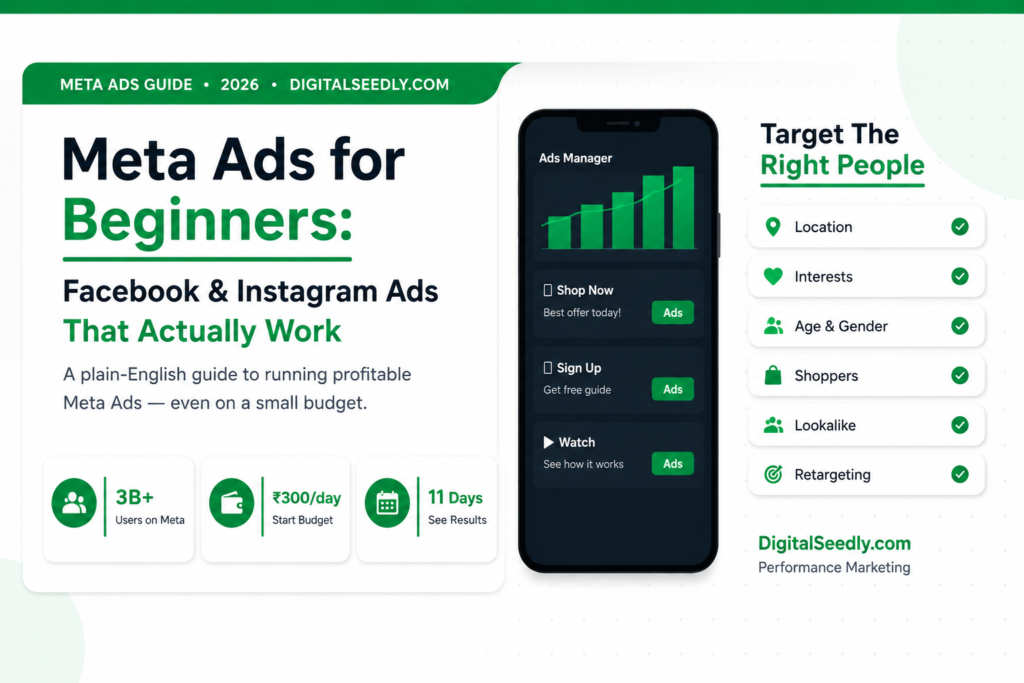
Meta Ads for Beginners: How Facebook & Instagram Ads Can Grow Your Business in 2026

👤 Author: Rishu Rana | 📅 Published: June 2026 | ⏱ Reading Time: ~12 min | 🎯 Skill Level: Beginner | 📂 Category: Paid Ads Meta Ads for small business is one of the most powerful ways to grow your sales on Facebook and Instagram in 2026—and in this guide, I am going to show you exactly how it works. Let me tell you something that happened last year. A small clothing boutique in Gurugram came to us at DigitalSeedly struggling to get new customers. We ran a simple Meta Ads for small business campaign—a carousel ad showing her top 5 outfits with a Shop Now button. In 11 days she got 1,400 website visitors, 47 new customers, and her sales that month doubled. She was spending less than ₹500 a day. I see small business owners scared of Meta Ads all the time. They think it is complicated. They think it is only for big companies. They think you need a marketing degree to figure it out. None of that is true. This is your complete Meta Ads for small business guide—written in simple words, just like I explain it to every new client who walks into DigitalSeedly for the first time. No jargon. No confusing charts. Just honest, practical steps you can follow today. Let us begin. What You Will Learn in This Blog → What Meta Ads actually are and why the name changed → Why Facebook and Instagram are the best places to advertise in 2026 → The different types of Meta Ads explained in plain language → How the Meta Ads algorithm works — simpler than you think → Step-by-step: how to set up your very first Meta Ad → Common beginner mistakes and how to avoid them → Meta Ads vs Google Ads—when to use each one → How to get results even on a very small budget First Things First — What Is “Meta”? You have probably heard of Facebook Ads. You may have heard of Instagram Ads. And now you are hearing “Meta Ads.” Are they all the same thing? Yes, almost. In 2021, Facebook’s parent company changed its name from Facebook Inc. to Meta. So now when we say “Meta Ads,” we mean ads that run across all of Meta’s platforms—which include Facebook, Instagram, Messenger, and WhatsApp in some regions. You run all of them from one single place called the Meta Ads Manager. So when you create one Meta ad for a small business, you can show it on Facebook, Instagram, or both—at the same time. Pretty convenient, right? Why Meta Ads for Small Business Are So Powerful in 2026 Here is a simple question. Where do most people spend time online every single day? Social media. Specifically Facebook and Instagram. Over 3 billion people use Facebook every month. Instagram has over 2 billion active users. These are not just young people. It is your neighbor, your customer, your customer’s mother, and your customer’s teenage daughter. All of them are scrolling. Now here is what makes Meta Ads for small businesses so special compared to anything else in digital marketing. You can choose EXACTLY who sees your ad. Not just “people in India.” I mean Women aged 28 to 45 Living in Delhi NCR Who are interested in handmade jewelry Who recently browsed jewelry websites And who earn above ₹50,000 per month You can target that specifically. That is why a small business with a small budget can punch way above its weight using Meta Ads. Think about a billboard on a highway. Everyone sees it — people who will never buy from you, people passing through, kids who cannot buy anything. You pay for all of them. With Meta Ads for small businesses, you only pay to show your ad to the exact people who are most likely to buy. That is the real game-changer. (Want to understand the full picture of online marketing first? Read our guide on what digital marketing really means—it covers everything from search to social to AI. The Different Types of Meta Ads — Explained Simply When you open Meta Ads Manager, you will see many options. Do not get overwhelmed. Here are the most important ad types and when to use each one. 1. Image Ads A single photo with some text and a button. Best for: Showing a product, a service, or a promotion. Example: A photo of your restaurant’s best dish with the text “Book a Table This Weekend.” 2. Video Ads A short video that plays in someone’s feed. Best for: Telling a story, showing a product in action, building brand awareness. Example: A 15-second clip showing someone using your skincare product with a visible result. 3. Carousel Ads Multiple images that people can swipe through inside one single ad. Best for: Showing multiple products, listing features, or telling a step-by-step story. Example: A clothing brand showing 5 different outfits in one ad, like our boutique client did. 4. Story Ads Full-screen vertical ads that appear between people’s Stories on Facebook and Instagram. Best for: Mobile users, quick attention-grabbing messages, limited-time offers. Example: “Flash Sale — 40% off today only!” with a swipe-up link. 5. Lead Ads Ads that include a small contact form built right inside the ad. The person never has to leave Facebook or Instagram to sign up. Best for: Collecting phone numbers, email addresses, or registrations. Example: “Download our free guide — just enter your name and email.” 6. Collection Ads An ad that opens a mini-storefront right inside Facebook or Instagram. Best for: Online stores with multiple products. Example: A fashion store where people can browse and buy 12 products without ever leaving the app. The best Meta Ads for small business campaigns usually start with either an image ad or a carousel ad. They are simple to set up and give you fast, clear results. How the Meta Ads Algorithm Works — Plain English Version A lot of people are scared of the Meta

Meta Ads for Beginners: How Facebook & Instagram Ads Can Grow Your Business in 2026 Read More »

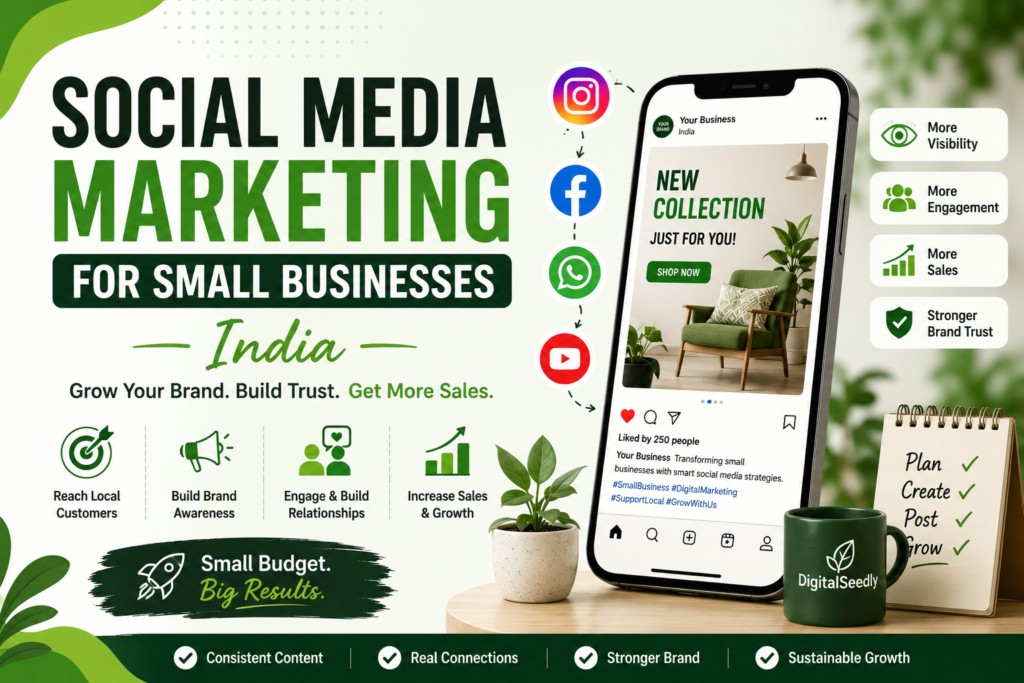
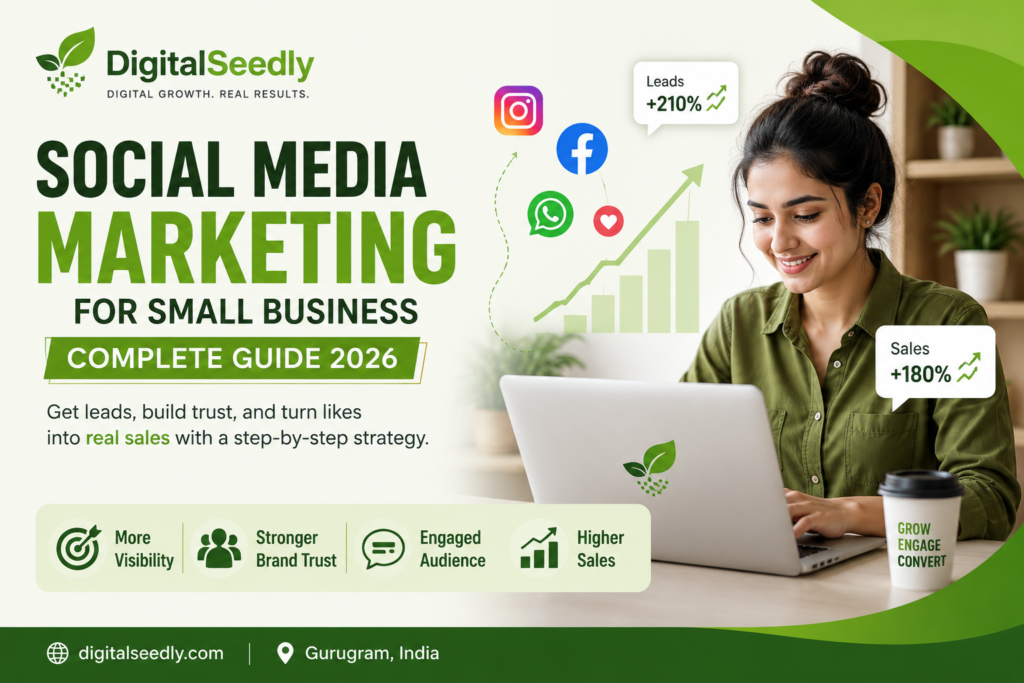
Small business owner using social media marketing to grow brand awareness, customer engagement, and sales in India through Instagram, Facebook, WhatsApp, and YouTube marketing.

How Social Media Marketing Actually Works for Small Businesses (And Why You Are Probably Overthinking It)

Author: Rishu Rana | DigitalSeedly Published: June 2026 Reading Time: ~10 minutes Level: Beginner — anyone can read this. Category: Social Media Marketing Tags: social media marketing for small businesses, how to grow on social media, Instagram marketing, Facebook marketing India, small business tips 2026 Let me start with something real. Last year, I was sitting with a client—a guy who runs a small clothing store in Ludhiana. He had good products. He had happy customers. But his business was not growing. I asked him one question: “Are you on social media?” He said, “Yes. But it does not work for me.” I looked at his Instagram page. He had posted 3 times in 6 months. All three posts were blurry product photos with no caption. No hashtags. No story. No engagement. I told him the truth: “It is not that social media does not work. It is that you have not really tried it yet.” Within 90 days, his page had 2,000 new followers. His DMs were full of order inquiries. He hired a helper just to handle the messages. Social media works. But most small business owners are either scared of it, confused by it, or doing it wrong. This blog is going to fix all three of those things. What Is Social Media Marketing? (Let Me Explain It Simply) Imagine your shop is in a big market. Thousands of people walk through every day. Some of them need exactly what you sell. Now imagine you could stand at the entrance of that market every single day and tell people about your shop. Show them your products. Answer their questions. Share happy customer stories. That is what social media marketing is. It is the act of using platforms like Instagram, Facebook, YouTube, and WhatsApp to talk to your customers, show your products or services, build trust, and — eventually — get more sales. The key word here is “talk,” not “sell.” Not shout. Talk. The businesses that do well on social media are the ones that treat it like a conversation—not a billboard. Why Social Media Is the Best Tool for Small Businesses in 2026 Here is something that used to be impossible. Twenty years ago, if you wanted to advertise your small business, you had to buy a newspaper ad, a radio slot, or a TV commercial. All of those cost lakhs of rupees. Most small businesses could not afford them. Today, you can reach 10,000 people in your city for ₹500. That is not an exaggeration. That is just how social media advertising works now. But even without spending a single rupee on ads, you can build a real following by simply showing up every day—posting, replying, sharing, and connecting. Here is why this matters so much for small businesses specifically: You do not need a big budget. You need consistency and creativity — both of which are free. You can target exactly the right people. Facebook and Instagram let you show your posts or ads only to people in your city, in a specific age group, or with specific interests. This means zero wasted reach. People buy from people they trust. Social media lets you build that trust faster than almost any other tool. When someone sees your face, hears your story, and watches you show up every day—they begin to trust you. And trust leads to sales. Your competitors are probably already there. And if they are not—that is an even bigger opportunity for you. The 5 Platforms That Matter Most (And Which One Is Right for You) You do not need to be everywhere. You need to be in the right place. Here is a simple breakdown: 1. Instagram Best for: Fashion, food, beauty, home décor, fitness, photography, local service businesses. Instagram is a visual platform. If your product or service looks good—or can be made to look good—this is your home base. Reels (short videos) are getting enormous reach right now, even for brand-new accounts. 2. Facebook Best for: local businesses, older audiences (30+), community-building, events, and Facebook Groups. Facebook is still the largest social platform in India. It is especially powerful for businesses that want to reach families, local customers, and people in smaller towns and cities. Facebook Marketplace is also a goldmine for product-based businesses. 3. YouTube Best for: Tutorials, how-to content, product demos, and businesses that can teach something. YouTube videos last forever. A video you make today can still bring you customers 3 years from now. If you have anything to teach, explain, or demonstrate, YouTube should be in your plan. 4. WhatsApp Business Best for: Every single local business. No exceptions. WhatsApp is the most used app in India. A WhatsApp Business account with a catalogue, quick replies, and broadcast lists can quietly become your single most powerful sales tool. And it costs nothing. 5. LinkedIn Best for: B2B services, consultants, agencies, coaches, and anyone who sells to other businesses. If your customer is another business—a company, a manager, an HR team, a startup founder—LinkedIn is where they spend their professional time. My recommendation for most small businesses in India: Start with Instagram and WhatsApp. Get comfortable. Then expand. What to Post? (The Question Everyone Is Stuck On) This is the part where most people freeze. “I do not know what to post.” Here is a simple rule I use with all my clients: The 4 Types of Content. Every post you make should fit into one of these four buckets: Bucket 1: Show What You Do This is the simplest content. A photo of your product. A video of your service in action. A before-and-after result. Behind-the-scenes of how you make something. People want to see what you actually do. Show them. Example: A tiffin service could post a 30-second video of fresh food being packed and delivered. Bucket 2: Help or Teach Something Share one useful tip that your customer would find helpful. This builds trust and shows that you know what you are

How Social Media Marketing Actually Works for Small Businesses (And Why You Are Probably Overthinking It) Read More »

n infographic illustrating SEO and Content Strategy. A magnifying glass hovers over a bar graph showing upward growth, with text indicating key digital marketing tactics.

What Is Digital Marketing? The Complete Beginner’s Guide (History, Benefits & How to Start in 2026)

DIGITALSEEDLY.COM What Is Digital Marketing? Your Complete Beginner’s Guide 👤 Author: Rishu Rana | 📅 Published: June 2026 | Category: Digital Marketing Basics | 🔄 Last Updated: June 2026 | ⏱ Reading Time: ~12 min | 🎯 Skill Level: Beginner | 📂 Category: Digital Marketing | 🏷 Tags: What is Digital Marketing, Digital Marketing for Beginners, Online Marketing, Digital Marketing History Let me ask you something. Right now, as you read this, someone somewhere is Googling “best cake shop near me.” Someone else is watching a YouTube ad for a new phone. Another person just clicked a sponsored Instagram post and bought a pair of shoes. All of that? That is digital marketing happening in real time. And here is the crazy part—it has been happening for 26 years. It did not start with Instagram. It did not start with Facebook. It started way back in the early days of the internet, and it has been growing, changing, and exploding ever since. In this guide, I am going to walk you through everything. What digital marketing actually is. How it started. What it looks like today. Why it matters for your business. And exactly how you can start using it—even if you have never done it before. I write this the same way I explain it to every new client who walks into DigitalSeedly. Simple. Clear. Human. Let us begin. What You Will Learn in This Blog: → What digital marketing really means (no fluff) → The full history—from 1994 to 2026 → The 7 main types of digital marketing explained simply → Why it works better than old-school marketing → The real benefits for your business → How to actually start — step by step → Why 2026 is the best time to start What Is Digital Marketing? (Explained Like You Are 10 Years Old) Okay. Imagine you own a small toy shop. Back in the old days, you would hang a sign outside your store. You would print flyers and hand them out in your street. Maybe you would put an ad in the local newspaper. That is called traditional marketing. It works. But it only reaches the people who see your sign, pick up your flyer, or read that newspaper. Now imagine this instead. You make a short video of your best-selling toy and post it on Instagram. 5,000 people watch it. You run a Google ad, and every time someone in your city types “toy shop near me,” YOUR shop shows up at the top. You send an email to 2,000 past customers telling them about a sale. You write a blog post about “top 10 toys for kids under 5,” and it starts showing up on Google. Now you are reaching thousands of people—without printing a single flyer. That is digital marketing. Digital marketing simply means promoting your business, product, or service using the internet and digital devices — like phones, computers, and tablets. It covers everything from Google ads to Instagram posts, from your website to your WhatsApp business account. If it uses a screen and the internet, it is digital marketing. The History of Digital Marketing: 26 Years That Changed Everything This is the part most people skip. But I think it is the most interesting part. Because understanding where digital marketing came from helps you understand where it is going—and why it is so powerful right now. Let us walk through it, decade by decade. 🗓️ 1994–1999: The Beginning. The First Banner Ad Changed Everything. The year was 1994. The internet was brand new. Most people had never used it. It was slow, clunky, and had almost no images. But then something happened that would change business forever. On October 27, 1994, the first ever internet banner ad went live. It was placed by AT&T on a website called HotWired.com. The ad said, “Have you ever clicked your mouse right HERE? YOU WILL.” And people clicked it. A lot. The click-through rate was 44%. (Today, the average is less than 0.1%. Times have changed.) That tiny banner ad started a revolution. By 1995, companies started building websites. By 1997, email marketing was born—companies started sending promotional emails to customers. By 1998, Google was founded, and the idea of “showing up when someone searches” became real. People started to realize: the internet is not just for nerds. It is a place where businesses can find customers. 🗓️ 2000–2006: Search Engines, Spam, and the First Crash The early 2000s were wild. Everyone wanted a website. Everyone wanted to rank on Google. Companies were throwing money at the internet without really understanding it. This led to what was called the “dot-com bubble”—a massive inflation of internet companies that mostly failed. But out of the chaos came something very important: Search Engine Optimization (SEO). Marketers discovered that if you used certain words on your website, Google would rank you higher. This was the birth of SEO as we know it today. Then in 2003, something called WordPress was launched—making it easy for anyone to build a website without being a programmer. And in 2004? Facebook was born. The world would never be the same. 🗓️ 2007–2012: Social Media Explodes. The Mobile Revolution Begins. By 2007, digital marketing had completely changed again. Twitter launched in 2006. YouTube launched in 2005 and was bought by Google in 2006. The iPhone launched in 2007—and with it, everything moved to mobile. Suddenly, people were not just using the internet on their computers. They were carrying the internet in their pockets. All day. Every day. This was a massive shift for marketers. Now they had to think about mobile websites, mobile ads, and reaching people wherever they were—not just at their desks. By 2010, Instagram had launched. By 2011, Pinterest had arrived. Businesses that understood social media were exploding. Those that ignored it were falling behind. One of the most important things that happened in this era: content marketing was born. Marketers realized that instead of shouting ads at people, you could

What Is Digital Marketing? The Complete Beginner’s Guide (History, Benefits & How to Start in 2026) Read More »

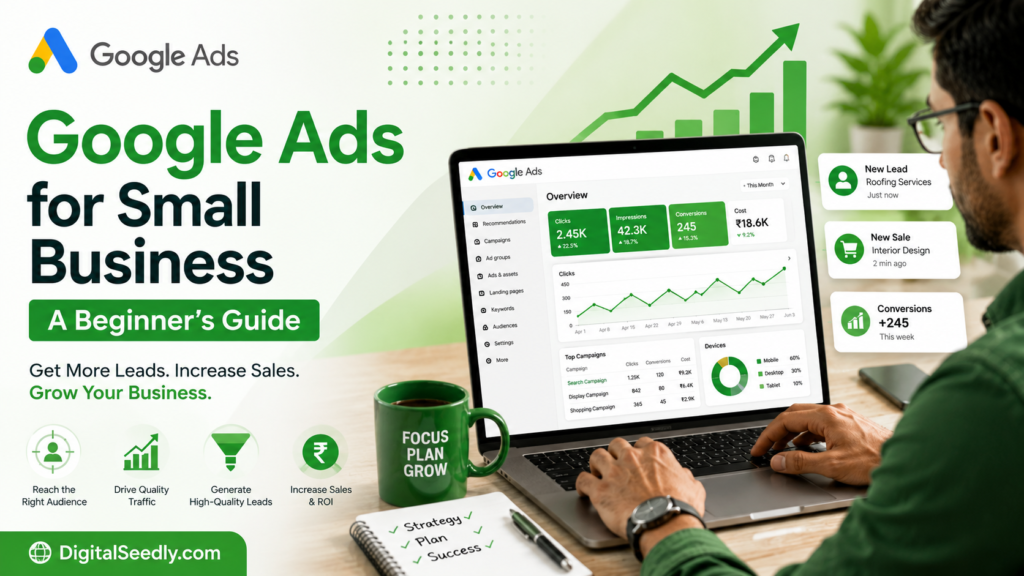
Google Ads for Small Business Beginner Guide showing campaign setup and business growth strategy

Google Ads for Small Business: A Beginner’s Guide That Actually Works

DIGITALSEEDLY.COM Google Ads for Small Business: A Beginner’s Guide That Actually Works 👤 Author: Rishu Rana | 📅 Published: June 2026| Category: Google Ads & Paid Marketing | 🔄 Last Updated: June 2026 | ⏱ Reading Time: ~8 min | 🎯 Skill Level: Beginner | 📂 Category: Google Ads |🏷 Tags: PPC, Google Ads, Small Business Marketing How to run Google Ads without wasting money — even if you’ve never done it before Let me ask you a question. Ever searched something on Google and seen those little ads at the top – the ones with a tiny “Sponsored” label? Ever wonder how they got there? And more importantly, did you ever wonder “Can my business be there too”? The answer is yes. And it is not as complicated or expensive as you think. My name is tied to the team at DigitalSeedly — a digital marketing agency based in Gurugram. We have helped dozens of small business owners run Google Ads for the first time. Some of them had budgets as small as ₹5,000 a month. And some of them — with the right setup — tripled their leads in 60 days. This guide is written the way I wish someone had explained it to me when I was starting out. Plain words. Real steps. No confusing jargon. What You Will Learn: By the end of this blog, you will understand: → What Google Ads actually is (and how it works) → Why it is powerful for small businesses → How to set up your first campaign step by step → Mistakes that waste your budget (and how to avoid them) → Tips to get better results even with a small budget What Is Google Ads? (Explained Like You Are 10 Years Old) Imagine you own a small bakery in your city. Someone opens Google and types: “best birthday cake near me.” Now—do you want YOUR bakery to show up right at the top of that search? Of course you do. That is exactly what Google Ads helps you do. Google Ads is a paid advertising platform. You pay Google a small amount every time someone clicks your ad. This is called PPC — Pay Per Click. You only pay when someone actually clicks, not just when your ad shows up. How Does Google Decide Which Ads to Show? Google does not just show ads from whoever pays the most. It looks at three things: Your bid — how much you are willing to pay per click Your Ad Quality Score — how relevant and helpful your ad is Your landing page — the page someone lands on after clicking your ad The better your ad quality, the LESS you pay per click. This is great news for small businesses. You do not need a huge budget. You need a smart, well-written ad. SEO Tip for This Section: KEY PHRASE: Google Ads campaign setup A well-structured campaign with good quality signals often beats bigger competitors spending 5x more budget. Why Google Ads Is Powerful for Small Businesses You might be thinking, “I am just a small business.” Do I really need this?” Here is the truth. Google processes over 8.5 billion searches every single day. Some of those people — right now, today — are searching for exactly what you sell. Google Ads puts your business in front of them at the perfect moment. The 5 Biggest Benefits of Google Ads for Small Businesses You only pay when someone clicks — not just when someone sees your ad. You can start with any budget — even ₹300 a day. You can pause or stop your ads any time you want. You can see exactly which ads are working and which are not. You reach people who are already looking for what you offer — not random people.   Google Ads vs. SEO: Which One Is Right for You? This is a question we get asked all the time at DigitalSeedly. Google Ads (PPC) SEO (Organic) Speed of results Instant (same day) Takes 3–6 months Cost Pay per click Time + content effort Best for Quick leads & sales Long-term traffic Control Very high Moderate Stops when… You pause the budget Never (keeps working)   The smartest businesses use BOTH. Google Ads brings fast leads today. SEO builds traffic that grows over time. If you want help deciding, our team at DigitalSeedly offers a free strategy call — no pressure, just clarity.   How to Set Up Your First Google Ads Campaign: Step by Step Let us walk through this together. Think of it like setting up a new shop—there are just a few steps, and once it is done, it runs on its own. Step 1: Know What You Want (Your Goal) Before you touch anything in Google Ads, ask yourself: What do I want people to do after clicking my ad? Call my business? Fill in a contact form? Buy something from my website? Visit my physical store? Your goal decides everything — the type of campaign, the keywords you pick, and the page you send people to. Do not skip this step. Step 2: Choose the Right Campaign Type Google Ads has many campaign types. For small businesses just starting out, here are the three most useful ones: Search Campaigns — Text ads that appear when someone searches on Google. BEST for most small businesses. Performance Max Campaigns — Google automatically runs ads across Search, YouTube, Gmail, and Maps. Good once you have some data. Local Campaigns — Perfect if you have a physical store and want foot traffic. Our recommendation for beginners: start with a search campaign. It is the most straightforward and gives you the most control. Step 3: Find the Right Keywords for Your Business Keywords are the words people type into Google. You need to choose keywords that match what your customers are searching for. For example, if you run a plumbing company in Delhi, good keywords might be the following: “plumber

Google Ads for Small Business: A Beginner’s Guide That Actually Works Read More »

The Ultimate SEO Guide for 2026: 10 Proven Strategies to Dominate Google Rankings

Let me be honest with you — but the right SEO strategies in 2026 can still deliver compounding organic growth. Google’s AI-powered ranking systems, zero-click search results, and the explosion of voice and visual search have completely reshaped what it means to ‘rank on Google.’ At DigitalSeedly, I’ve spent years managing SEO campaigns for brands across industries — from e-commerce startups in Gurgaon to SaaS companies competing globally. And what I’ve learned is this: businesses that treat SEO as a checkbox activity consistently fall behind, while those who build it into their core growth strategy see compounding returns year after year. This guide is everything I wish someone had handed me at the beginning. Whether you’re starting from scratch or trying to unlock the next level of organic growth, these 10 strategies are your roadmap.   SEO Strategies 2026: Why Organic Still Wins With the rise of paid ads and social media, some people have been saying ‘SEO is dead’ for years. It’s not. In fact, organic search still drives over 53% of all website traffic globally. The difference is that winning at SEO now requires strategy, not just keyword stuffing. Here’s the truth: paid ads stop working the moment you stop paying. SEO keeps delivering traffic, leads, and revenue even while you sleep. That’s the power of organic — and it’s why I made it a cornerstone of everything we do at DigitalSeedly.   📊 Why Organic Traffic Is Your Best Long-Term Asset Organic search generates 53% of all web traffic. Companies investing in SEO see 14x more ROI over 3 years compared to those relying solely on paid channels. At DigitalSeedly, our clients average a 3x increase in organic traffic within 6 months.   Strategy 1: Master Search Intent Before You Write a Single Word Understanding What Google Really Wants The number one mistake I see businesses make is writing content they think people want, not content Google knows people want. Search intent is the foundation of modern SEO — and getting it wrong means even perfectly optimized content will fail to rank. The Four Types of Search Intent Informational: The user wants to learn something (e.g., ‘how does Meta Ads targeting work’) Navigational: The user wants to find a specific website or page Commercial Investigation: The user is comparing options (e.g., ‘best SEO agency in India’) Transactional: The user is ready to buy or take action Before creating any content, I always search the target keyword myself and analyze the top 5 results. That tells me exactly what format Google is rewarding — listicle, how-to guide, comparison, or video.   Strategy 2: Build Topical Authority, Not Just Backlinks Why Topic Clusters Beat Individual Blog Posts Google’s Helpful Content Update fundamentally changed how authority is measured. It’s no longer enough to have one great article about SEO. Google now evaluates the breadth and depth of your expertise across an entire topic. At DigitalSeedly, I build what we call ‘content ecosystems’ — a pillar page covering a broad topic supported by 8-15 cluster articles covering subtopics in depth. This approach signals expertise to Google and captures long-tail traffic at scale. How to Build Your Topical Authority Map Identify your core service or expertise area (e.g., ‘Google Ads management’) Create a comprehensive pillar page (2,500+ words) on that topic Develop 10+ supporting articles covering specific subtopics Interlink all articles naturally with keyword-rich anchor text Update content quarterly to maintain freshness signals   Strategy 3: Technical SEO — Technical SEO Strategies for 2026 You Can’t Skip Core Web Vitals & Page Experience Signals Technical SEO is the unsexy work that makes everything else possible. I can’t count the number of beautiful websites I’ve seen hemorrhaging rankings because of a slow load time or broken internal links. Google is extremely clear: if your site doesn’t provide a good technical experience, content quality won’t save you. Critical Technical SEO Checklist for 2026 Core Web Vitals: LCP under 2.5s, FID under 100ms, CLS under 0.1 Mobile-First Indexing: Your mobile site IS your SEO — optimize it first HTTPS Security: A basic requirement; HTTP sites are flagged as insecure Crawlability: Clean XML sitemaps, logical robots.txt, no orphaned pages Structured Data: Schema markup for articles, FAQs, products and local business Site Architecture: Every page reachable within 3 clicks from the homepage At DigitalSeedly, every website we build is engineered for technical SEO from day one — not bolted on as an afterthought.   Strategy 4: Keyword Research in the Age of AI Search How SEO Strategies in 2026 Go Beyond Search Volume to Search Potential Traditional keyword research focused on monthly search volume. In 2026, I look at three additional dimensions: search intent alignment, keyword difficulty vs. your domain authority, and the presence of AI-generated answers at the top of results pages. If Google is already answering a query with an AI-generated overview (formerly SGE), you need either to rank #1 organically to get cited in that overview, or target related long-tail variations where AI hasn’t fully captured the space yet. My Personal Keyword Research Framework Seed Keywords: Start with 10 broad terms that define your business Competitor Gap Analysis: Find keywords your competitors rank for that you don’t Long-Tail Mining: Target 5+ word phrases with clearer commercial intent Question Keywords: Capture ‘People Also Ask’ boxes with direct-answer formats Local Intent Keywords: Critical for service businesses targeting specific cities Strategy 5: Content That Earns Links Without Asking Creating Genuinely Link-Worthy Assets Backlinks remain one of Google’s strongest ranking signals. But the era of buying 500 directory links for ₹2,000 is not just dead — it’s actively dangerous. Manual penalties from Google can tank a domain for months. The strategy that consistently works for my clients is creating what I call ‘reference content’ — original data, comprehensive guides, industry tools, and frameworks that people in your industry naturally want to cite and link to. High Link-Earning Content Formats Original research and surveys with proprietary data Free tools and calculators (e.g., ROI calculator, ad budget planner) Definitive

The Ultimate SEO Guide for 2026: 10 Proven Strategies to Dominate Google Rankings Read More »